


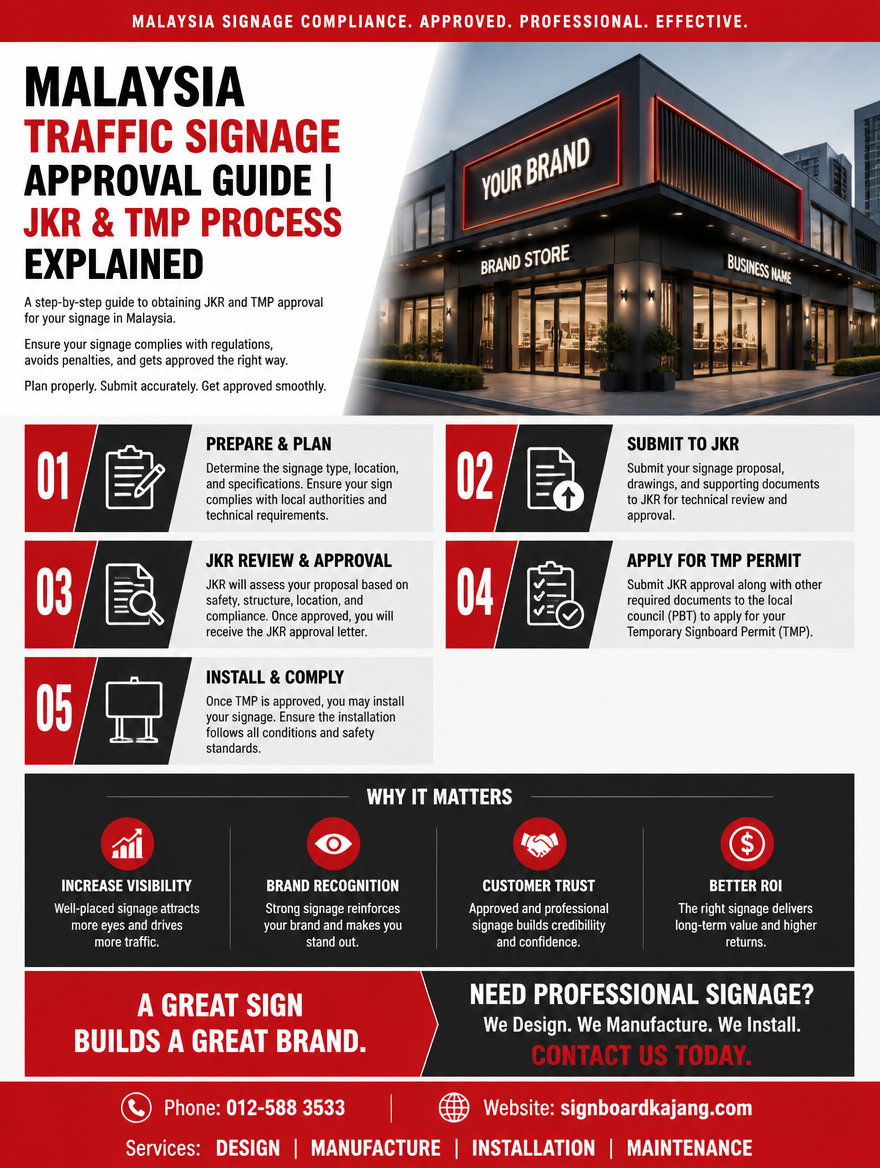
Malaysia Traffic Signage Approval & JKR Compliance Guide: Improving Project Approval Success and Execution Efficiency
In Malaysia (including KL, Selangor, Penang, Kuantan, and Johor Bahru), Traffic Control Signage used in road works, construction sites, and commercial developments is part of the JKR (Jabatan Kerja Raya) regulated engineering compliance system.
In real projects, common issues include:
- Signage design not meeting JKR standards, leading to rejection
- Incomplete Traffic Management Plan (TMP) submission
- Unclear approval process causing project delays
- Improper on-site signage setup during construction stages
This article explains the key JKR compliance requirements for traffic signage approval in Malaysia, along with common challenges and a systematic approach to execution.
JKR Traffic Signage Approval Requirements (Malaysia Standard)
1. JKR & ISO Design Standards
Traffic signage must comply with MS / ISO standard symbol systems, JKR road design guidelines, and clear readability and consistent visual presentation.
The main goal is to ensure drivers can quickly and easily recognize information at different viewing distances.
2. Traffic Management Plan (TMP) (Key Approval Document)
The TMP is the core requirement in the approval process and typically includes:
- Traffic flow arrangements during construction
- Temporary traffic control measures
- Safety and risk management planning
- Driver guidance and behavior control strategies
In KL and Johor Bahru projects, the TMP is often the deciding factor for approval success.
3. Visibility & Installation Standards
Traffic signage must ensure: clear visibility during daytime, high night-time reflectivity (Reflective Sheet materials), proper sight distance for driver reaction time, and correct installation height based on road type and usage context.
Approval Process in Malaysia (Simplified Steps)
Step 1: Design Stage — Develop the traffic signage layout and initial design concept.
Step 2: Traffic Management Plan (TMP) Preparation — Prepare a complete traffic management document covering construction-phase traffic control and safety planning.
Step 3: Submission to JKR / Local Council — Submit all required documents for official review and approval.
Step 4: Review & Revisions (If Required) — Make adjustments to the design or layout based on authority feedback.
Step 5: Approval & Implementation — Once approved, proceed with construction, installation, and on-site execution.
Common Reasons for Approval Rejection in Real Projects
In industrial zones and commercial developments across Selangor, Penang, and other regions, approval issues often occur due to:
- Inconsistency between signage design and actual site conditions
- Incomplete or overly simplified Traffic Management Plan (TMP)
- Failure to consider changes in traffic flow patterns
- Insufficient night-time visibility
- Lack of layered traffic control design
Result: repeated revisions and delays that can last for weeks.
How to Improve JKR Approval Success Rate (Key Engineering Strategy)
To increase approval success, the focus is not on "visually attractive design", but on proper engineering logic:
- Early traffic flow planning (Traffic Flow Planning)
- Well-structured and complete TMP documentation
- Layered traffic signage system design
- Consistency between design and on-site implementation
In large-scale projects in KL and Johor Bahru, these factors directly determine the speed and success of approval.
Application Scenarios
- Construction sites
- Road upgrading or improvement projects
- Industrial park traffic planning
- Commercial developments (e.g. malls or mixed-use complexes)
- Highway construction zones
Project Self-Check List (Approval Risk Assessment)
Before submission, please ensure:
- Does the design comply with JKR standards?
- Is a complete Traffic Management Plan (TMP) prepared?
- Is a reflective system in place for night visibility?
- Are all signs positioned within proper driver sight distance?
Any uncertainty in these areas may affect the approval outcome.
Summary: Compliance-Based Traffic Signage Is Key to Smooth Approval and Safe Project Execution
In Malaysia's traffic engineering system, the value of Traffic Control Signage lies in its compliance framework and systematic traffic planning capability.
From JKR standards, Traffic Management Plan (TMP) preparation, to on-site implementation, every stage directly affects approval speed, construction safety, and project execution efficiency.
Standardized traffic signage = higher approval success rate + lower construction risk + improved project efficiency
FAQ
1. Can I apply for traffic signage approval without a Traffic Management Plan (TMP)?
In most cases, it is not recommended. A TMP is a key document required for construction and road-related approvals, covering overall traffic control and safety management strategy.
2. Do small commercial projects also need traffic signage approval?
It depends on the project impact. If the development affects public roads, access points, or parking circulation, approval from the relevant local authority is usually required.
3. What are the key factors to consider in traffic signage design?
Key considerations include visibility distance, driver reaction time, road speed limits, installation positioning, and night-time reflectivity performance.
4. Do different road types require different traffic signage standards?
Yes. Highways, urban roads, industrial areas, and construction zones all have different requirements in terms of sign size, spacing, and warning levels.
5. Do small-scale projects still need a full traffic management plan?
If the project affects public roads or traffic flow, even small-scale works are recommended to prepare at least a basic traffic management plan to reduce approval risks.
We provide complete traffic signage solutions across Malaysia (KL / Selangor / Penang / Johor Bahru), including: JKR-standard traffic signage design, construction traffic planning & layout design, approval documentation preparation & technical support, and one-stop fabrication and installation service.
Helping your project reduce approval risk and achieve higher first-time approval success rates.
Call / WhatsApp Us: 012-588 3533 Website: signboardkajang.com
Disclaimer: Information provided is for reference only. We do not bear responsibility for any inaccuracies or consequences arising from its use.



